
Primary tabs

Esther Viola Kurtz

https://music.wustl.edu/xml/faculty_staff/14399/rss.xml
Esther Viola Kurtz

Esther Viola Kurtz

Assistant Professor of Ethnomusicology,
Performing Arts Department (Affiliate), 
Department of African and African-American Studies (Affiliate),
(On sabbatical Spring 2026)

BM, Eastman School of Music
MM, Utrecht School of the Arts in the Netherlands
Ph.D, ethnomusicology at Brown University
Research interests:
    Afro-Brazilian music and dance
  • racial politics
  • ethnographic ethics
View All People

Contact info:

  • Pronouns: She/Her
  • Email: ekurtz@wustl.edu
  • Phone: 314-935-5581
  • Office: Blewett Hall, 304

Professor Kurtz’s research focuses on Afro-Brazilian music, sound, movement, and dance practices. She teaches courses on topics such as ethnographic methods, ethnomusicology, sound and dance studies, jazz, and American popular music.

Her first book, A Beautiful Fight: The Racial Politics of Capoeira in Backland Bahia, is now available for pre-order at University of Michigan Press on its Music and Social Justice series. The ethnographic study explores capoeira’s powerful potentials to motivate antiracist political action while also critically examining the implications of growing white participation in such a spiritual and political Afro-Brazilian practice. The book argues that white practitioners occupying space in capoeira divert attention from Black members’ concerns and reproduce colonialist logics of extraction, thus complicating claims that shared music/dance bridge difference and facilitate cross-racial unity. Yet while this hinders capoeira’s potentials to improve Black lives, the book proposes that capoeira nevertheless transmits knowledge, tools, and wisdom that can be leveraged to collaboratively contest racist coloniality and imagine a more just world. Her second book project extends her concerns about racial politics to consider how jazz musicians in St. Louis navigate the conditions of late racial capitalism to make a living, theorize their tradition, build community, and define their own value system.

Professor Kurtz has published in Women & Music, Ethnomusicology, Journal of the Society for American Music, and Conversations Across the Field of Dance Studies. She has presented at national and international conferences, including at annual meetings of the Brazilian Studies Association, the Society for Ethnomusicology, the Dance Studies Association, the Collegium for African Diasporic Dance, Analytical Approaches to World Music Conference, and the Society for American Music.

Courses:

Undergraduate:

Music, Sound and the Body

American Popular Music and Media

History of Jazz

Introduction to Ethnomusicology


Graduate:

Methods and Ethics of Music Ethnography
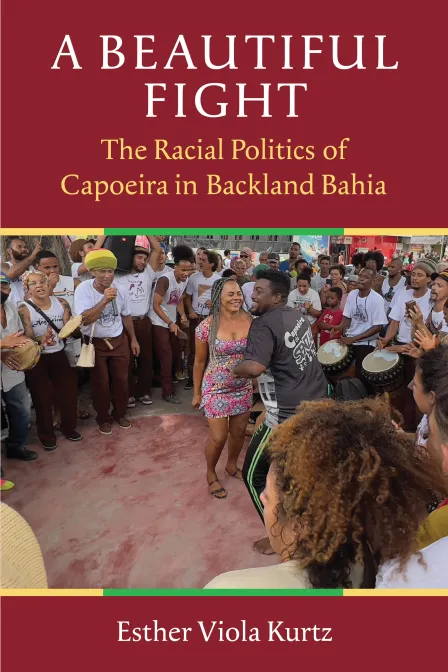
A Beautiful Fight: The Racial Politics of Capoeira in Backland Bahia

A Beautiful Fight: The Racial Politics of Capoeira in Backland Bahia

A Beautiful Fight examines the potentials and limits of capoeira Angola to cohere a multiracial community committed to antiracist struggle. Capoeira, a musical fight-game that originated among enslaved Africans in Brazil, holds special significance for Black Brazilian activists as a spiritual and political practice that affirms the value of Black lives, thus countering anti-Black violence sanctioned by the Brazilian state. However, many capoeira groups count more white practitioners than Black, especially groups of the politicized, Afrocentric style capoeira Angola, raising debates about appropriation of Black culture that resonate across the Americas. A Beautiful Fight addresses these tensions. Drawing on ethnographic research with a multiracial capoeira Angola group in Brazil’s Bahian sertão or backlands, Esther Viola Kurtz explores diverse group members’ understandings of capoeira’s spiritual and political meanings and considers how white participation impacts capoeira’s antiracist politics. A Beautiful Fight argues that white practitioners occupying space in capoeira divert attention from Black members’ concerns and reproduce racist and colonialist ideologies, albeit unintentionally. In this way, the book complicates claims that shared music and dance bridge differences and facilitate cross-racial unity, yet Kurtz proposes that capoeira still transmits knowledge and tools that, when used with intention, commitment, and care, can be wielded to collaboratively contest racism and imagine a more just world.