
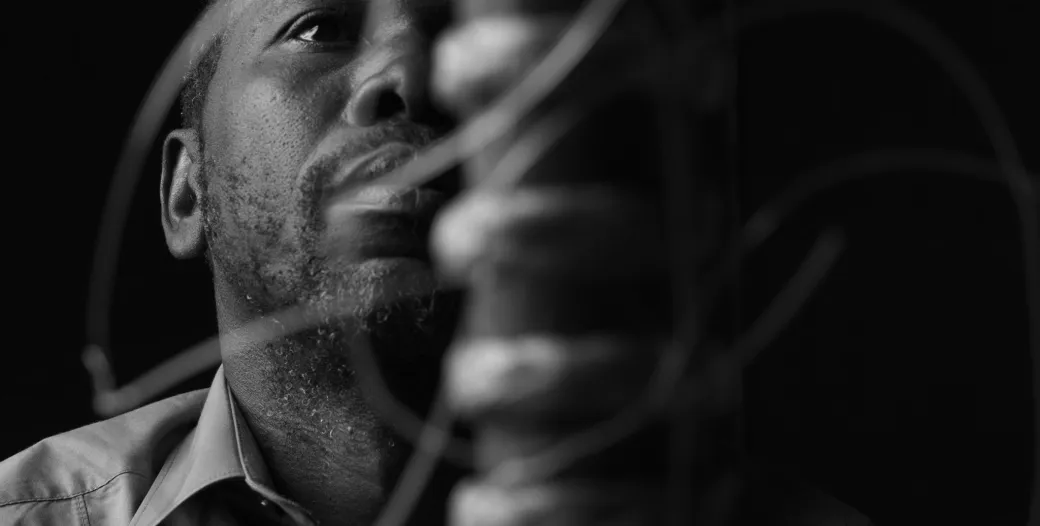
Artist Talk: Ballaké Sissoko, kora
Master kora virtuoso Ballaké Sissoko will be joined by Professor of Music Patrick Burke and Senior Lecturer in African and African American Studies El Hadji Samba Amadou Diallo in a conversation about the kora and its significance in West African musical traditions.
Biographies
Ballaké Sissoko
After the success of Djourou, the Malian virtuoso returns for an intimate tête à tête with his kora – intimate yet simple and majestic.
On his last album Djourou, Ballaké Sissoko explored new horizons by inviting musicians as varied as Salif Keita, Arthur Teboul (Feu! Chatterton), Camille, Oxmo Puccino, Vincent Segal and Patrick Messina, Piers Faccini to collaborate with him. The highly praised release was a demonstration of the art of musical conversation, Ballaké style, that plaited new strands into the long cord or ‘djourou’ that links him to other musicians and to the history of the kora. There’s no doubt that Ballaké owes his taste and talent for the musical encounter to his consummate listening skills. But they’re also the fruit of the long conservations he never tires of having with his own instrument.
During these strange and paradoxical ‘solitary dialogues’, he makes his kora speak and reacts to the emotions it arouses in him, letting his imagination and his fingers fly off to landscapes that are both magnificent and unknown. It’s there that his qualities as an improviser can be accurately measured, qualities that he began cultivating long ago in the shadow of the venerable elders of the Instrumental Ensemble of Mali, when he was still a young boy. Taking time off from the Djourou sessions, Ballaké recorded these eight instrumental pieces in the intimate confines of the Chapelle Sainte-Apolline in Belgium. Together they proclaim, without need for further evidence, the heights of mastery and freedom that this discreet giant of global music has scaled in his forty-year-long career.
Though two of the pieces also feature on Djourou, the new album gathers together all eight of them in a musical conversation between a master, made of flesh and spirit, and his ‘double’, made of string and wood. It’s a captivating, intimate and authentic testament, recorded in one afternoon, in which Ballaké takes us on a journey, a meandering trip full of majesty that borders on the sacred and touches serene meditative uplands as well as plains criss-crossed by Manding warriors straight out of the epics of a country of whom they are the pride. Ballaké is that country’s best ambassador. He was recently invited by the famous COLORS studio in Berlin to play ‘Nan Sira Madi’, the song that opens the new album. As for the title ‘A Touma’, take it to mean ‘this is the moment’: the moment for Ballaké to share the fruits of his maturity, and for us to discover and be blown away.
The CD and vinyl editions of ‘A Touma’ will be available exclusively to Nø Førmat! subscribers.
Patrick Burke
Patrick Burke received his B.A. in music at the University of Pennsylvania (1996) and his Ph.D. in ethnomusicology at the University of Wisconsin-Madison (2003). Since 2004, he has been a professor of music at Washington University in St. Louis, where he teaches undergraduate and graduate courses on such topics as the history of jazz and popular music, music of the African diaspora, and the methods and theories of ethnomusicology. In 2013-14, he was a Guest Scholar at the University of Oslo, Norway, and he served on the editorial board of the Journal of the American Musicological Society from 2013 to 2018. In past years, Prof. Burke has served as Director of Undergraduate Studies and Head of Musicology in the Department of Music.
Prof. Burke's research centers on jazz and popular music in the United States, with a focus on the relationship between music's performance and reception and the formation of racial ideology. His work has been supported by fellowships from the American Musicological Society, the American-Scandinavian Foundation, the National Endowment for the Humanities, the Rock and Roll Hall of Fame, the Social Science Research Council, and the Center for the Humanities at WashU. Prof. Burke is the author of Come In and Hear the Truth: Jazz and Race on 52nd Street (University of Chicago Press, 2008) and Tear Down the Walls: White Radicalism and Black Power in 1960s Rock (University of Chicago Press, 2021). He was also project director, researcher, and writer for the digital humanities project Music and Racial Segregation in Twentieth-Century St. Louis: Uncovering the Sources (link below). Prof. Burke’s current research addresses the role of the Norwegian shipping industry in establishing Western ideas and stereotypes about music of the global South during the Age of Empire. In addition to his academic work, Prof. Burke is a guitarist and composer. He has also performed in a Javanese gamelan and on the amadinda, a Ugandan xylophone.
El Hadji Samba Amadou Diallo
El Hadji Samba Diallo joined African and African American Studies in 2011 to expand the language offerings by teaching Wolof. Since joining, he expanded his course offerings to include classes on Islam, Sufism, and Francophone Africa.
His research explores the ways religious institutions reproduce themselves and how adherents accept as natural, the interpretation of those institutions by their leaders. Diallo uses a variety of international archives in France and Senegal as well as ethnographic research. His first book was entitled La Tijāniyya sénégalaise: Les métamorphoses des modèles de succession (Paris: Publisud, 2010). In addition to the book, he has published several articles on the expansion of the Tijāniyya brotherhood in French Colonial History, Africa Zamani, Incursions, and Social Compass. His most recent publications have examined the dissemination of Sufism and Islam as well as democratization processes in Africa.
His current research project explores musical influences between Africa and its diaspora. Inspired by his popular freshman seminar, Youth in Africa, the research looks to newer diasporic connections taking place via dance and the movement of Hip-Hop. The connections include a variety of music such as Zouk, Cabo Love, and Kizomba, stretching from Cape Verde, Angola, the Netherlands, France, and Portugal to Brazil and the Antilles.
In addition to his teaching and research commitments, Diallo continues to work with graduate and undergraduate students while fostering connections with African communities in St. Louis. To this end, he organizes many events on campus, including the annual Ñiari Ràkka conference with African Islamic leaders and scholars of Islam.
Before coming to Washington University, Samba taught courses at Southern Illinois University at Edwardsville. He received his doctorate in History and Social Anthropology from the École des Hautes Études en Sciences Sociales (EHESS) in Paris, France in July 2005.
Support
In collaboration with St. Louis Classical Guitar

WashU Department of African & African American Studies
Financial assistance for this project has been provided by the the Regional Arts Commission and the Missouri Arts Council, a state agency.

Website for the Missouri Arts Council
Website for the Regional Arts Commission